
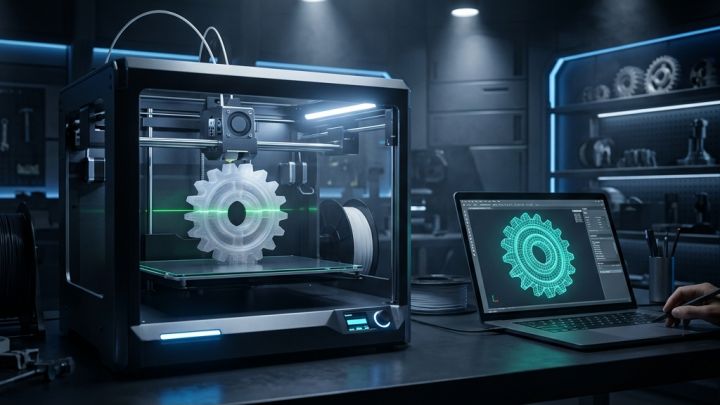
Industrial designers and engineering teams leverage generative tools to accelerate product prototyping. Translating initial concept drawings into production-ready physical files historically requires days of manual modeling and adjustment. To eliminate these development bottlenecks, Neural4D offers an automated geometric reconstruction pipeline. Jointly developed by Nanjing University, DreamTech, the University of Oxford, and Fudan University, Neural4D utilizes the Direct3D-S2 architecture to convert 2D inputs into high-resolution digital prototypes.
For manufacturing studios looking to convert 2D sketches to CAD models, geometric accuracy determines output usability. Standard generative systems often produce open-boundary meshes that cannot be processed by CNC machines or 3D printers. The Neural4D engine addresses this limitation by generating clean, watertight meshes with quad-dominant topology, allowing designers to export assets directly into production pipelines.
Technical Architectures of Industrial 3D Generators

To evaluate leading systems, manufacturing engineers must analyze the underlying mathematics of generative engines. Early tools that rely on dense voxel representations suffer from high computational overhead. Representing complex curves of physical prototypes at high resolutions requires immense memory, limiting the scalability of the prototyping workflow.
To resolve these computational limitations, Neural4D introduces the Spatial Sparse Attention (SSA) mechanism. By focusing processing resources exclusively on the active surfaces of the prototype model rather than empty volumetric space, SSA optimizes GPU utilization. This architectural design delivers an approximate 12x speedup in inference time compared to dense volumetric tools. As a result, industrial design teams can run batch generations of assets without relying on large hardware clusters.
Other options like Tripo3D and Luma Genie serve alternative purposes. Tripo3D uses projection-based diffusion to generate models quickly, but often outputs unstructured meshes that distort dimensions. Luma Genie converts continuous neural fields into polygons, which frequently introduces noise and open boundaries. These issues require manual correction before the models can be imported into standard CAD programs.
Mesh Topology and Fabrication Compatibility
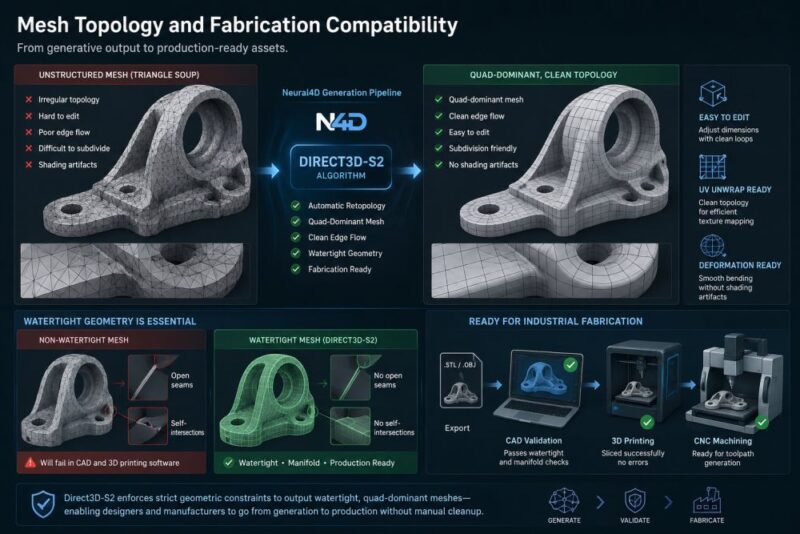
In commercial production, the utility of a 3D asset depends on its polygon structure. Many generative engines output unstructured meshes, often called “triangle soup,” which are difficult to edit. This irregular geometry prevents designers from adjusting dimensions or applying subdivisions.
To make generated models production-ready, Neural4D incorporates automatic retopology within its generation pipeline. The engine outputs quad-dominant meshes, ensuring clean edge flow along the surfaces of the model. Having clean topology allows designers to modify details easily, apply texture coordinates, and deform meshes without shading artifacts.
Achieving watertight mesh geometry is essential for industrial fabrication. If a model contains open seams or self-intersecting polygons, CAD applications and 3D printers will fail to process the file. The Direct3D-S2 algorithm enforces strict geometric constraints to output watertight meshes, allowing manufacturers to send generated files directly to 3D printing software or CNC machines.
Dynamic Lighting and PBR Texture Separation
For high-end rendering, 3D prototype models must respond realistically to ambient lighting. A major drawback of standard generators is baked-in lighting, where highlights and shadows are permanently painted onto the diffuse texture map. When these models are placed in different virtual environments, the static lighting conflicts with the scene light sources, destroying visual consistency.
To provide production-grade assets, Neural4D isolates geometry generation from texture creation. Its material-separation algorithm outputs a clean Physically Based Rendering (PBR) workflow, providing separate albedo, normal, and roughness maps. Because the textures do not contain dead shadows, the models react naturally to real-time light changes, allowing designers to relight them in any virtual environment.
Understanding the generation timeline helps teams plan their design schedules. Neural4D generates the raw base mesh geometry (the untextured white model) in approximately 90 seconds. Completing the high-resolution PBR textures and exporting the final GLB model requires a separate processing step, bringing the total completion time to just over 2 minutes. This workflow allows designers to approve the model shape before generating detailed textures.
Performance Comparison of Leading Generators
The following table compares the performance of the leading generative tools for physical prototyping:
| Metric | Neural4D | Tripo3D | Luma Genie |
|---|---|---|---|
| Underlying Architecture | Direct3D-S2 | InstantMesh / Tripo | Gaussian Splatting / NeRF |
| Resolution Output | 2048³ Native | 512³ Estimated | 512³ Resampled |
| Topology Quality | Quad-dominant (Clean) | Triangle Soup (Unstructured) | Triangle Mesh (Fragmented) |
| Base Mesh Time (s) | 90 | 20 | 60 |
| PBR Texture Output | Separated Albedo / Normal | Baked Shading | Baked Lighting |
| Mesh Structure | Watertight | Open boundaries | Non-manifold holes |
This comparison highlights why high-resolution generation is necessary for creative design. While fast diffusion models are useful for quick concept brainstorming, their unstructured outputs require extensive manual cleanup. By providing clean topology and PBR texture outputs, Neural4D reduces post-processing bottlenecks for design teams.
Digital Asset Ecosystems and Collaboration
Accelerating design workflows also depends on accessing a diverse library of baseline assets. Industrial designers frequently source royalty-free commercial shapes to kickstart their projects and share feedback on rendering configurations. Participating in these platforms helps teams benchmark their generated outputs against community standards and optimize their settings.
Collaborating within these networks also allows designers to share optimization tips for different rendering engines. This ecosystem supports rapid prototyping, enabling artists to bring new characters to market faster.
Future Trends in Conversational Prototyping
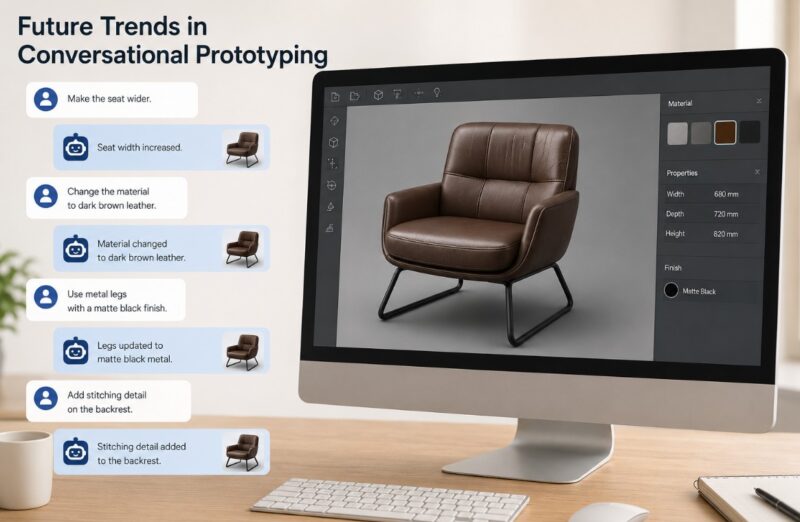
The development of conversational interfaces is changing how designers edit 3D assets. Early generative models operated as closed systems, requiring users to restart the generation if a single element was incorrect.
To offer precise control, the Neural4D-2.5 model supports conversational text commands to modify specific parts of the geometry or adjust material properties. Using text prompts, designers can adjust dimensions, change materials, or refine details of the mesh. Note that Neural4D-2.5 is designed exclusively for 3D functions (Text to 3D and Image to 3D). The independent 2D image and video generators do not support these interactive updates; adjustments to those formats require submitting a new prompt.
Selecting a high-fidelity generation platform is essential for modern design studios. By adopting Neural4D, manufacturers can reduce prototyping cycles from days to minutes, maintaining compatibility with evolving industrial standards.